2 Review for Exam 2
2.1 Definitions and Vital Concept
Chapter 8: GDP
- Gross Domestic Product (GDP) –- what does it measure?
- Final good and intermediate good
- Total Production = Total Income = Total Spending
- Components of GDP: What is included in C, I, G, NX?
- Limitations or imperfections of GDP
- Calculating Nominal GDP, Real GDP, and the GDP Deflator
- Calculating inflation from Nominal and Real GDP
- Other measures of total production and total income: GNP, National income, disposable income, etc
Chapter 9: Unemployment and Inflation
- How we segment the population with regards to Unemployment
- Household survey and employment survey
- Calculating unemployment rate, labor force participation rate, and the employment-population ratio
- Discouraged workers
- Distinguishing the three types of unemployment: Frictional, Structural and cyclical
- Full employment and the Natural Rate of Unemployment
- Calculating the Consumer Price Index (CPI)
- Calculating inflation
- Indexation
- Shortcomings or imperfections of CPI: Substitution Bias, Quality Bias, New goods Bias and Outlet Bias
- Nominal vs. Real Interest rates and their relationship
- Uses of CPI: Converting prices to today’s dollars, converting nominal variables to real variables
Chapter 10: Longrun Economic Growth, Saving + Investment, Business Cycle
- Distingish GDP, real GDP and real GDP per capita
- Calculating growth from one year to the next
- “Constant growth rate rule”: given the economy grows at different rate for several years, what would be the equivalent constant rate of growth?
- Two ways of average growth rates: simple and compound
- Rule of 70
- Determinants of long-run economic growth
- Actual vs. Potential GDP
- Financial System: financial markets vs. financial intermediaries
- Direct finance vs. indirect finance
- Savings (private, government and national/aggregate saving) and Investment Identity
- Distinguish the difference between Saving and investment
- The Market for Loanable Funds-– Analyzing effects of shifts and movements along.
- Crowding out
2.2 Sample Multiple Choice
- Suppose GDP in 2020 was $21 trillion and GDP in 2021 was $22.5 trillion. By what percentage did the economy grow from 2020 to 2021?
- 5.3%
- 6.5%
- -7.1%
- 7.1%
- GDP is an imperfect measure of a country’s well-being because it does not capture
- The amount of government involvement in the economy
- How much leisure time a country takes.
- How much a country spends on goods.
- GDP is a perfect measure of well-being.
- Which of the following best describes inflation?
- Severe, negative decline in the level of prices in an entire economy.
- An outburst of high changes in the level of prices in an entire economy.
- A unit-free number derived from the price level over a number of years.
- A general and ongoing rise in the level of prices in an entire economy.
- Suppose an economy’s GDP has a constant growth rate of 4%. How long will it take for the economy’s GDP to double?
- 17.5 years
- 175 years
- 14 years
- 35 years
- Which of the following best describes Potential GDP?
- positive short run relationship between the price level for output and real GDP, holding the prices of inputs fixed.
- The amount of total spending on domestic goods and services in an economy.
- The maximum quantity that an economy can produce given full employment of its existing levels of labor, physical capital, technology, and institutions.
- The total quantity of output firms will produce and sell.
T/F: While the sale price of old car by a dealer is not part of GDP, the dealer’s commission is
If GDP 90 million, Consumption 50 million, Investment 15 million, Government purchases 20 million and exports 8 million, what is the value of imports
2.3 Workout
- Consider the following table:
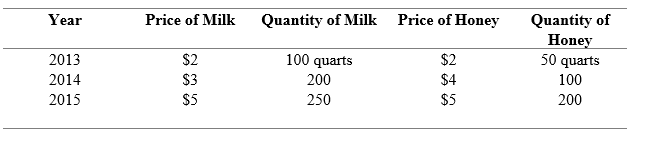
- Calculate nominal GDP for 2015:
- Calculate real GDP for 2015 using 2013 as the base year:
- Calculate the GDP deflator for 2015 using 2013 as the base year:
- What is the inflation rate from 2013 to 2014? From 2014 to 2015?
- The Bureau of Labor Statistics announced in October 2018, of all adult residents of Letterkenny, 3,500 were employed, 500 were unemployed, and 1,000 were not in the labor force. (Note: you will need to calculate the adult population and labor force)
- Calculate the unemployment rate:
- Calculate the labor-force participation rate:
- Consider the following table: Note that a basket consists of 100 quarts of milk and 50 quarts of honey.
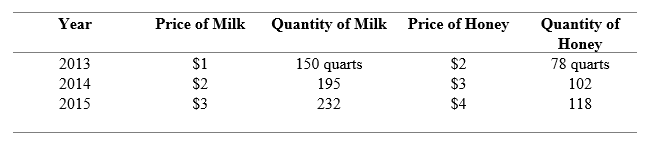
- Using 2013 as a base year, calculate the CPI in 2014:
- Using 2013 as a base year, calculate the CPI in 2015:
- Calculate the inflation rate from 2014 to 2015:
Suppose your mother received a salary of $45,000 in 1991. What is the value of that salary in 2016 dollars if the CPI in 1991 was 136 and the CPI in 2016 was 240?
Real GDP per capita in the United States grew at rate of 2.25 percent from 2010 to 2011. If the United States had continued to grow at this rate how long would it have taken for the economy to double?
Consider the following economic information of the economy of Asgard:
- GDP = $500 million
- Consumption = $350 million
- Investment = $100 million
- Government Purchases = $50 million
- Taxes = $75 million
- Transfer Payments = $40 million
Calculate public saving, private saving, and national (aggregate) saving
- Draw the graph of the Market for Loanable Funds that demonstrates the effects on interest rate and quantity of investment when there is:
- crowding out due to government spending or reduction of taxation
- when government mandates 401K in all firms